
How Long Should I Keep Going If Therapy Doesn't Feel Helpful the First Few Sessions?
You've gone three or four times now. You rearranged your schedule for it. You paid for it. You talked about things you don't talk about. And you feel about the same as you did before you started.
So you're doing the math. Is this worth it? Should I try someone else? Should I just stop?
That's a reasonable question to ask. It's also, in our experience, the single most common point at which people quit therapy right before it starts working.
How long should I give therapy before deciding it isn't working?
If the only problem is that you don't feel dramatically better yet, three or four sessions is usually too early to judge. Research on therapy outcomes and our own client data both point to roughly 8 to 12 consistent sessions as a more reasonable checkpoint. Some people notice smaller shifts sooner. Very few have enough information at session three.
There's an important word in there: consistent. We'll come back to it, because it's doing more work than most people realize.
If what you're really asking is how to recognize progress when you see it, we wrote a separate post on how to know if therapy is working. This one is about something narrower. You're early, you're frustrated, and you're deciding whether to keep going.
Why don't I feel better after three or four sessions?
Some of it is arithmetic. Your first session or two goes largely to history, assessment, and figuring out what's actually maintaining the problem. Treatment planning takes a session. Then the actual intervention starts.
So by session four, you may only be two or three sessions into the part of treatment designed to change anything.
The rest of it is that real change takes repetition. Jill Hasso, LPC, one of our therapists, put it this way:
"Real, lasting change takes time and work, and you might not notice the benefit right away. That requires a certain amount of faith and trust in the process, which can be hard when you're investing a significant amount of money into your mental health every month while still experiencing the problem that brought you to therapy."
That tension is real and we're not going to pretend otherwise. You're paying for something whose whole value proposition is that it takes a while.
Three sessions over two months is still only three sessions
This is the part almost nobody accounts for.
People measure therapy in calendar time. "I've been in therapy for two months." But calendar time isn't the thing that changes anything. Sessions are.
"Two months of therapy" might mean eight weekly appointments. It might also mean this: you went twice the first month, canceled once when work blew up, your therapist was out one week, you went once in month two, then something came up and you rescheduled to three weeks later.
That's three sessions. Spread across nine weeks.
This isn't a criticism. Life genuinely does that, and most people who end up in that pattern aren't being flaky. But it means you haven't really had a course of treatment yet. You've had three appointments with a lot of distance between them, and you're about to conclude that therapy doesn't work for you.
If a doctor prescribed physical therapy twice a week for six weeks and you made it to three appointments over two months, you probably wouldn't decide physical therapy doesn't work on knees. You'd know you hadn't done it yet.
Why does momentum matter so much at the beginning?
Here's what a well-spaced week actually looks like.
You learn something in session. Over the next seven days you notice the pattern happening in real life. You try the new response. It half works. You get stuck somewhere specific. You come back, describe exactly where it broke down, and your therapist helps you adjust. You try the better version. That's a full learning cycle in fourteen days, and you get another one right after it.
Now stretch that to every three or four weeks.
You learn something. You try it twice. It's awkward, so you drop it. Three stressful things happen. By the time you're back in the room, ten minutes go to catching your therapist up on what's happened since, another few to remembering what you were even working on, and you've lost the thread. You're not building. You're restarting.
The research points the same direction. One analysis of depression treatment found that the number of sessions per week was strongly associated with how much people improved, while the total number of sessions and the overall length of therapy were barely associated with outcome at all. Spacing matters, not just the count.
We've written more about the research behind our weekly recommendation if you want the full version.
It's also not just about showing up. It's about doing the work between sessions, even when the skills feel clunky and you're not sure yet what you're doing. That's most of where the change actually happens.
What our own numbers show about the first eight weeks
We measure outcomes. Every client completes standardized symptom measures throughout treatment, so we're not guessing about whether people are improving. Here's what that data shows, and we think it makes this argument better than any general advice could.
For clients who start with moderate to severe anxiety
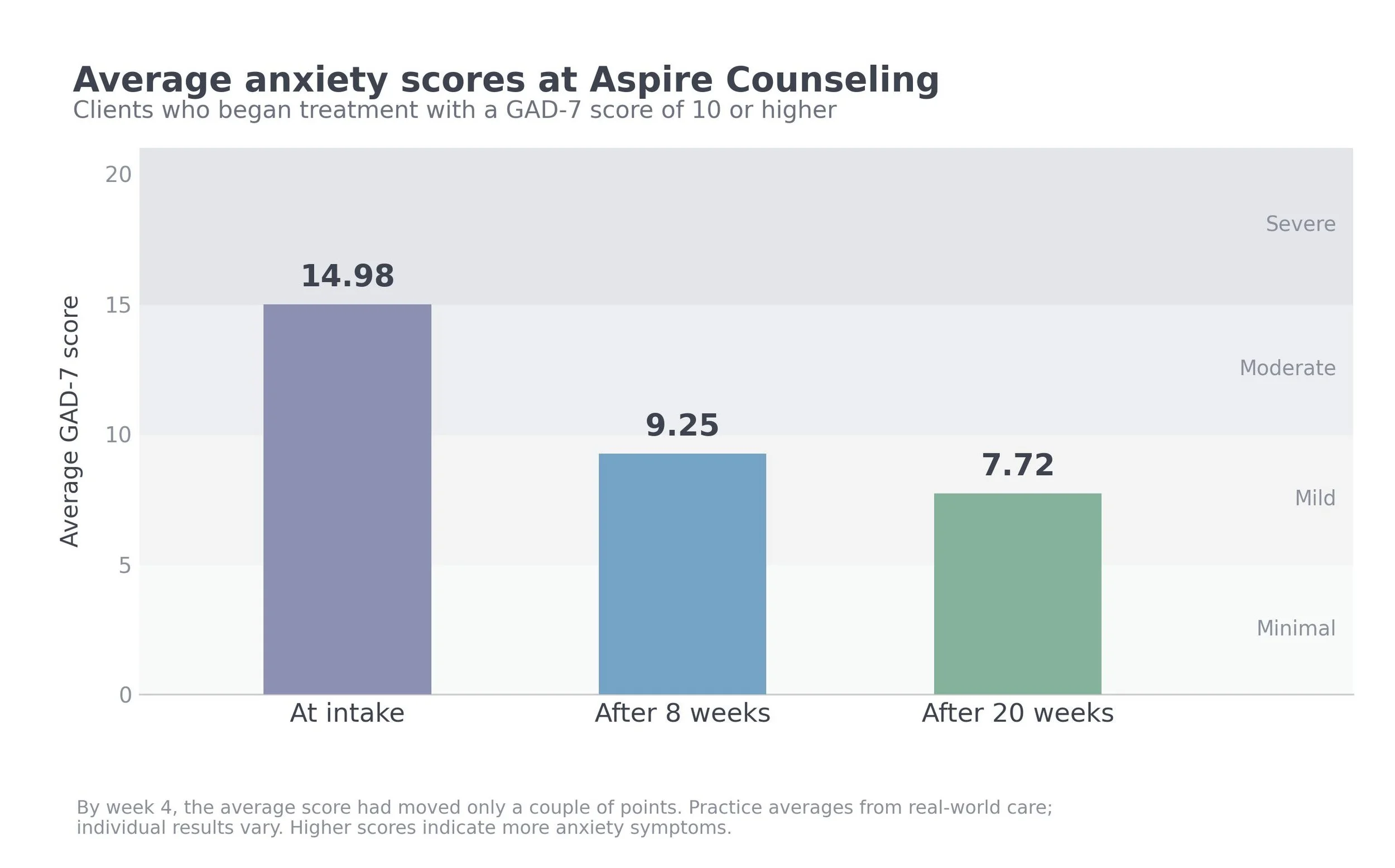
For clients with moderate or several anxiety at Aspire Counseling (our real collects using data collected over hundreds of clients the last several years), we know that after only four weeks of counseling, their scores have moved only a little bit.
If you stopped after only four weeks, you'd have gone to therapy for a month, felt barely different, and concluded it wasn't working. However, the average person in that group who kept going was in a meaningfully different place four weeks later.
Our 8 week data shows that on average clients have dropped more than five points. In other words, they’ve moved from moderate or severe anxiety to kind of the top of that mild range.
Yes, it helps to continue toign to therapy. Our 20 week data shows us people get even better a few months later.
But as specialists in anxiety treatment, we understand that those first 8 weeks of treatment are critical for building momentum and making some initial progress.
For clients who start with significant PTSD symptoms
Our data for treating trauma and PTSD tells a similar story, but it does take a little bit longer.
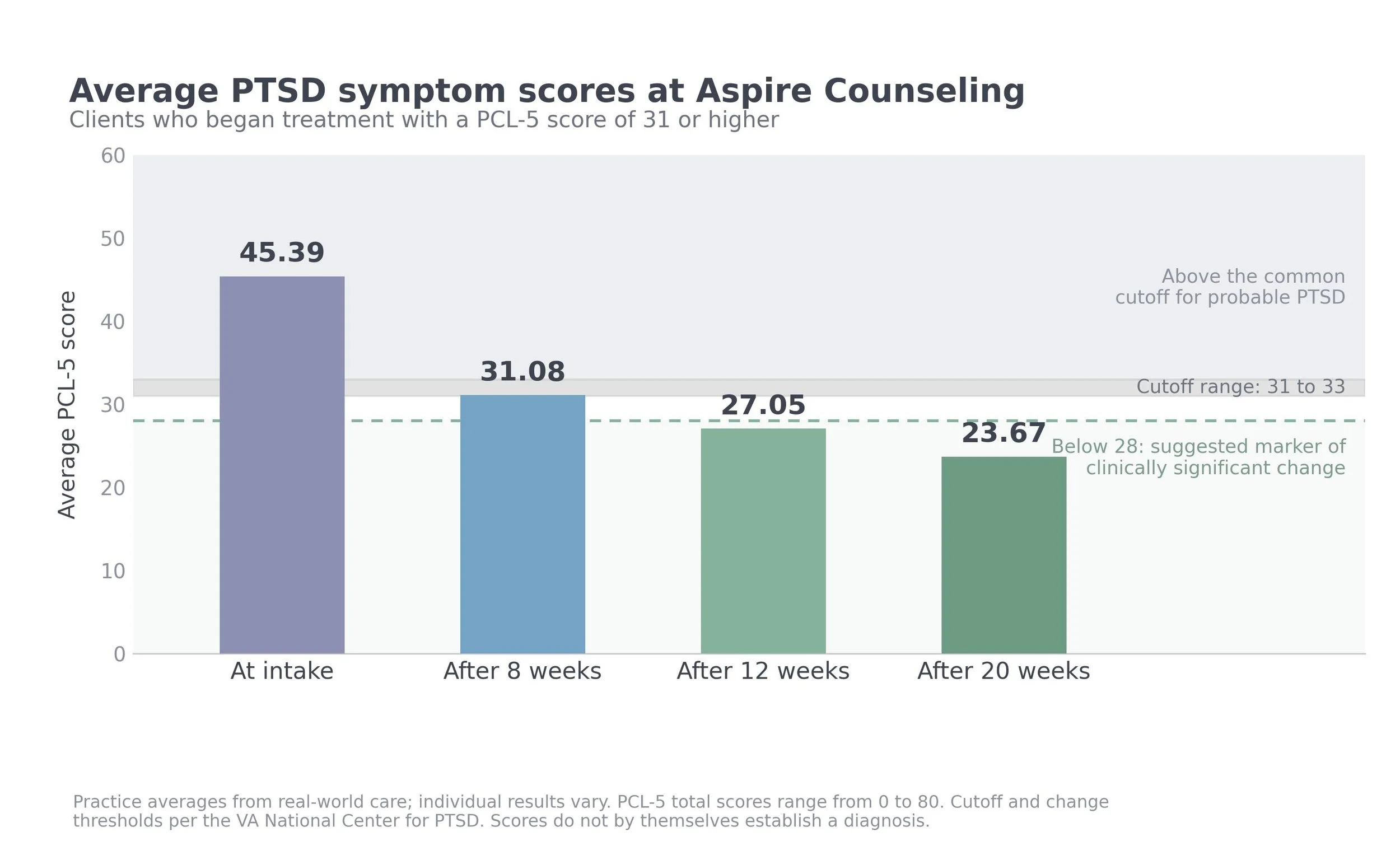
That drop of more than 18 points in those first 12 weeks is a large change. On the PCL-5, a decrease of about 10 points is generally considered a meaningful treatment response, so this is close to double that. In practical terms, a change that size can mean fewer intrusive memories, less time spent avoiding, feeling less constantly on guard, and more room to actually participate in work, parenting, and relationships.
A few honest caveats. These are averages from our own practice, not results from a controlled trial. Individual outcomes vary quite a bit. Some people improve faster and some need considerably longer, especially with more complex trauma. And while we believe the weekly structure is a real part of why those first eight weeks move the way they do, our own data can show us a pattern, not prove a cause.
By the time clients finish trauma treatment with us, the average PCL-5 score is 21.71. That number reflects people who completed a course of treatment, so it doesn't include everyone who started. For many people, a change of this size can mean that trauma is no longer taking up the same amount of space in everyday life—fewer intrusive memories, less avoidance, less time feeling on edge, and more freedom to be present at work, in relationships, and in the parts of life that matter to them.
But for our purposes today, the important thing to understand is that meaningful change tends to really start showing up somewhere in that 8 to 12 session window, not at session three.
Should I feel better after every session?
No, and grading therapy session by session will mislead you.
Some sessions you'll leave lighter. Some you'll leave tired, raw, or annoyed at something your therapist pointed out. That's not a scoreboard. It's normal variation in a process where you're deliberately turning toward things you've been working hard to avoid.
We want to be careful here, because a lot of mental health content jumps straight to "if it feels bad, it's working." That's not true either. A hard session should have a point, and you should be able to ask what it was.
What matters is the trajectory. Are you avoiding less? Recovering faster after something sets you off? Doing things you couldn't do two months ago? Are the numbers moving? That's the measure, and it's not visible week to week. It's visible across weeks.
What if weekly sessions aren't realistic for my budget?
This is the real reason a lot of people space sessions out, and it deserves a straight answer instead of a lecture about commitment.
If cost is the constraint, say that out loud to your therapist. Sometimes there are options: a shorter, more focused course of treatment delivered consistently, out of network benefits you haven't used, or a different plan for how to sequence the work.
The one thing we'd push back on is treating every other week as the cheaper version of the same treatment. It's often not. It can take substantially longer to get to the same place, which sometimes means paying more in total for a slower result. We laid out that tradeoff in more detail in is therapy every 2 weeks enough.
And the more your symptoms are already interfering with daily life, the more this matters. If anxiety is keeping you off the highway, if OCD is eating hours of your day, if PTSD is affecting your sleep and your work, then one 45 minute appointment every three weeks is a very small intervention compared to everything else happening in those weeks.
What should you understand by session three or four, even if you don't feel better?
You might not have symptom relief yet. But you should be able to answer these:
What does my therapist think is keeping this problem going?
What treatment are we using?
What am I actually going to be doing in this?
What are we working toward?
How will we know if it's helping?
If those are getting clearer, the treatment is on track even if your symptoms aren't yet. If they're not, that's a different problem and it's worth naming. What your therapist should actually be doing in sessions covers what to expect there.
When you shouldn't wait it out
Nothing in this post means stay no matter what. There's a real difference between "I'm not better yet" and "something is wrong here."
Don't wait for session ten if:
You feel judged or dismissed, more than once
You've asked what you're working toward and can't get a clear answer
There are no agreed goals and no apparent plan
Your symptoms are getting substantially worse and nothing is changing in response
Something about the relationship feels off in a way you can't explain away
Any of those is worth acting on now. Sometimes that means a direct conversation with your therapist. Sometimes it means a different therapist. We wrote about what to do when the fit isn't right, and switching is a normal thing to do, not a failure.
What if you get to 8 to 12 consistent sessions and still aren't better?
Then you have real information, and it's the right time to ask harder questions.
Is your therapists’ understanding of the problem right? Is this the right treatment for the problem, or would something more specific help more? Is the frequency right? Is the between session work actually happening? Is a different level of care needed?
That's a different conversation than the one you'd be having at session three, and it's a much more productive one. It's also, honestly, part of why we measure. We don't want you paying for therapy that isn't moving anything either. If the numbers aren't shifting, we'd rather see that clearly and change something than keep going on vibes.
If you've done a full course of treatment before and it didn't help, that's worth reading about separately, because the answer is often that the treatment was mismatched rather than that therapy doesn't work for you.
Begin Therapy in Lee's Summit, Columbia, or Online in Missouri
If you're a few sessions in somewhere and discouraged, the most useful thing you can do this week is say so to your therapist. That conversation is more likely to change something than quietly disengaging.
And if you're deciding where to start, we'd rather tell you honestly up front what treatment is going to ask of you. We use specific, evidence-based approaches for trauma, OCD, and anxiety, we track whether they're working, and we ask people to commit to weekly sessions early on because that's when it counts most.
Call us at 816-287-1116 for Lee's Summit or 573-328-2288 for Columbia. We see clients in person at both offices and online throughout Missouri.
Whenever you're ready for effective care and lasting change, we're here.
About the Author & Data
Jessica Oliver, MSW, LCSW is the founder and Clinical Director of Aspire Counseling. She has more than fifteen years of clinical experience specializing in trauma and anxiety, with advanced training in EMDR, Cognitive Processing Therapy, Prolonged Exposure, ACT, and Exposure and Response Prevention. She built Aspire Counseling around a simple idea: people dealing with trauma, OCD, and anxiety deserve treatment that actually moves the needle, delivered by clinicians who track whether it's working.
Outcome data reflects Aspire Counseling clients measured through our outcome tracking system. These are practice averages from real-world care rather than results from a controlled research study, and individual outcomes vary. Standardized measures are used to track symptom change over time and do not by themselves establish or rule out a diagnosis.