

Our Columbia, MO Counseling Office
Columbia has been home to Aspire Counseling since we opened in 2017. Our office sits just south of the University of Missouri campus, and we see clients from across mid-Missouri — Mizzou students navigating some of the hardest years of their lives, families in south Columbia ready for something to actually change, professionals learning to live authentically in line with their values and everyone in between.
We believe good therapy does two things well. It's grounded in research. And it feels genuinely human. Those aren't competing ideas. At Aspire, we've built a practice, and a physical space, around both.
What does Aspire Counseling specialize in?
Aspire Counseling specializes in trauma, PTSD, OCD, anxiety, grief and stress. We work with adults, teens, and children. Our therapists hold advanced training in evidence-based treatments, and we invest in ongoing education so that training stays current.
We're not a generalist practice. We've built our team around specific areas where evidence-based treatment works best and where specialized training makes a real difference in outcomes.
OCD Treatment through Exposure and Response Prevention (ERP)
If you or your child has OCD, the treatment that works is ERP — Exposure and Response Prevention. ERP is the gold standard, and the research on it is clear. The problem is that ERP is underused, because it takes specific, hands-on training to deliver well. A lot of therapists are willing to see OCD clients but haven't actually trained in ERP. Ours have. Furthermore, they sit on a regular consultation team where we discuss our OCD cases and make sure the clients are getting the benefit of a team of ERP therapists rather than only one. We offer ERP for adults, teens, and children.
Trauma and PTSD Treatment
For adults and teens, our primary trauma treatments for adults struggling with trauma histories and PTSD symptoms are Cognitive Processing Therapy (CPT) and EMDR. Both are among the most research-supported approaches available for PTSD, and our therapists hold advanced training in both. Some of our therapists have additional training in other trauma therapies such as Prolonged Exposure. But the bottom line is that PTSD treatment is just what we do.
Some therapists say they are “trauma informed.” That’s not us. We are…but we go well beyond that. This use of evidence based treatment means that we can help the people who’s trauma has impacted their life to the point they worry they will never be the same. Trauma therapy isn’t part of what we do. Rather, it’s what we specialize in.
For children, our child trauma therapists use TF-CBT (Trauma-Focused Cognitive Behavioral Therapy) which is designed specifically to help younger clients process trauma in a developmentally appropriate way. These therapists are extremely passionate about their work. They love how TF-CBT has such strong evidence behind it yet allows them the creativity to make the treatment relevant to the individual child and fully support the parents.
Having multiple strong trauma treatment options matters. Not every approach fits every person or every trauma history. We can meet you where you are.
Anxiety, panic, and avoidance
Anxiety treatment is one of our core strengths — and we want to be specific about why.
For many concerns, CBT and ACT are genuinely helpful. They build skills, shift patterns, and give people tools they can use. Our therapists pull from both when it fits. But the gold standard for treating anxiety is exposure therapy, and that's where we've invested the most.
Exposure therapy works by gradually and systematically helping you face what you've been avoiding — with support, at a pace that's manageable. It sounds simple, but doing it well takes real training and clinical skill. We're good at it. We've seen it change things for people who had tried other approaches for years.
We specifically treat:
Panic disorder — including the fear of having another panic attack, which can become its own trap
Agoraphobia — we can begin with online sessions if leaving home feels impossible right now, then work toward in-person as you build confidence
Social anxiety — including the kind that quietly shrinks your world over time without you fully realizing it
School refusal in children and teens — which is almost always anxiety-driven, and which responds well to exposure-based treatment when it's done right
If anxiety has been getting in the way and previous therapy hasn't moved the needle, exposure work may be what was missing.
Grief Counseling
Grief doesn't always need treatment. However, sometimes it gets stuck, and when it does, having the right approach matters. And Grief Counseling can help you move through the painful parts of loss, make meaning and move forward still acknowledging the beautiful connection you have with a person you lost or the roll something you lost played in your life.
Three of our Columbia therapists are formally trained in an EMDRIA-approved EMDR Grief Protocol. This is a structured, evidence-based approach specifically designed for grief processing, and it's particularly helpful when grief feels frozen, intrusive, or like it's not moving in the way you'd expect. It's different from general EMDR, and the training to deliver it well is specific.
Beyond those three, all of our clinicians are equipped to treat traumatic grief. Because our entire team is trained in trauma therapy, we're well-positioned to work with grief that's complicated by the circumstances of a loss — sudden deaths, violent loss, suicide loss, or any death that carries its own trauma alongside the grief.
Several of our Columbia therapists also use ACT (Acceptance and Commitment Therapy) for grief — a meaningful approach for helping people live alongside loss rather than waiting to feel "over it."
Whatever brought you to grief, you don't have to have it categorized perfectly before you call. We'll help you figure out what fits.
Affirming care for LGBTQ+ clients
We want to say something specific here, because "LGBTQ+ affirming" has become a phrase that can mean almost anything.
For us it means more than a welcoming attitude. It means clinical experience. Over the course of Aspire's history, three of our therapists have themselves identified as transgender, and LGBTQ+ therapists have been part of our team from the very beginning. Those colleagues have shaped how our practice thinks, what we've learned, and how we show up for LGBTQ+ clients. We've benefited from their presence, and so have our clients.
In practice, that means our therapists understand the coming out experience — but they also understand that coming out looks very different depending on a person's age, family, community, and history. A younger trans client who had affirming parents and a supportive friend group may not find their gender identity to be a source of pain at all. An older client who came out later in life may be carrying decades of something very different. Our therapists know how to follow your lead rather than assume.
Every therapist at Aspire has worked with transgender clients specifically — not just LGB clients. That distinction matters clinically, and we don't want to paper over it.
We don't ask other clients to understand or agree with anyone else's experience. That's not what we're saying. What we are saying is that this is a space where every client is free to be fully themselves — whatever that looks like for them — and where no one has to manage how they present in order to feel safe.
That's not just language to us. It's something we've worked to build, and it's something we protect.
What makes Aspire different?
At Aspire Counseling, clinical depth and genuine warmth aren't in conflict. We take evidence-based training seriously. We also take the felt experience of therapy seriously: the relationship, the environment, and meeting each client as a real person.
Here's what that actually looks like:
Our training runs deep. Every therapist at our Columbia office is trained in Cognitive Processing Therapy for trauma and PTSD. Several hold training in Prolonged Exposure as well. Our therapists who work with children are trained in TF-CBT. And our OCD specialists have completed rigorous ERP training. This isn't a list of introductory certifications — it's a team that has put in serious clinical hours in specific areas.
We keep learning. At Aspire, ongoing education isn't optional. Our full-time therapists have dedicated support for advanced trainings in evidence-based care. All of our clinicians complete continuing education throughout the year. We stay current because what we know about treating trauma, OCD, and anxiety keeps improving — and our clients deserve that.
We track outcomes. We use Blueprint, a measurement-based care platform, to track how clients are doing over time. Each month, clients complete brief check-ins using validated tools like the PHQ-9, GAD-7, and PCL-5. We're not guessing whether therapy is working. We're measuring it.
We're private pay. We don't bill insurance, which means we're not constrained by session limits, diagnostic requirements, or a plan's definition of "medically necessary." We can give you the level and type of care you actually need — not what an insurance company will authorize.
Who do you see?
We see adults, teens, and children. We work with people from all different backgrounds, belief systems, and walks of life. Our only real requirement is that you're ready to do the work.
Our Columbia therapists see clients dealing with trauma, PTSD, OCD, anxiety, grief, depression, stress, and life transitions. We also see a lot of college students — if you're at Mizzou, Columbia College, or anywhere else in the area, we understand the specific pressures that come with that season of life.
We see people from across mid-Missouri. Some clients drive in from smaller towns outside Columbia. Some are Mizzou faculty or staff. Some are professionals dealing with things that have been building for years. Some are parents whose kids are struggling. We don't have a typical client.
Everyone is welcome here. We mean that in the full sense. Every therapist at Aspire has experience working with lesbian, gay, bisexual, transgender, and queer clients. We want to be specific about that — because there's a real difference between a therapist who is willing to see LGBTQ+ clients and one who has actual training and experience with those concerns. Trans-related issues require a different clinical knowledge base than LGB concerns, and our therapists have worked with trans clients specifically.
That same welcome extends to clients who come from deeply conservative backgrounds, strong faith traditions, small-town Missouri communities, or anywhere else. You don't have to share your therapist's worldview to do good work together. We don't assume anything about you when you walk in, and we don't ask you to leave your identity or your values at the door.
We've intentionally kept our space free of anything that signals a particular religious tradition or political leaning. We see clients who are Christian, Jewish, Muslim, agnostic, atheist, and everything in between. We want everyone to walk in and feel like this is a place that has room for them.
What is the Columbia office like?
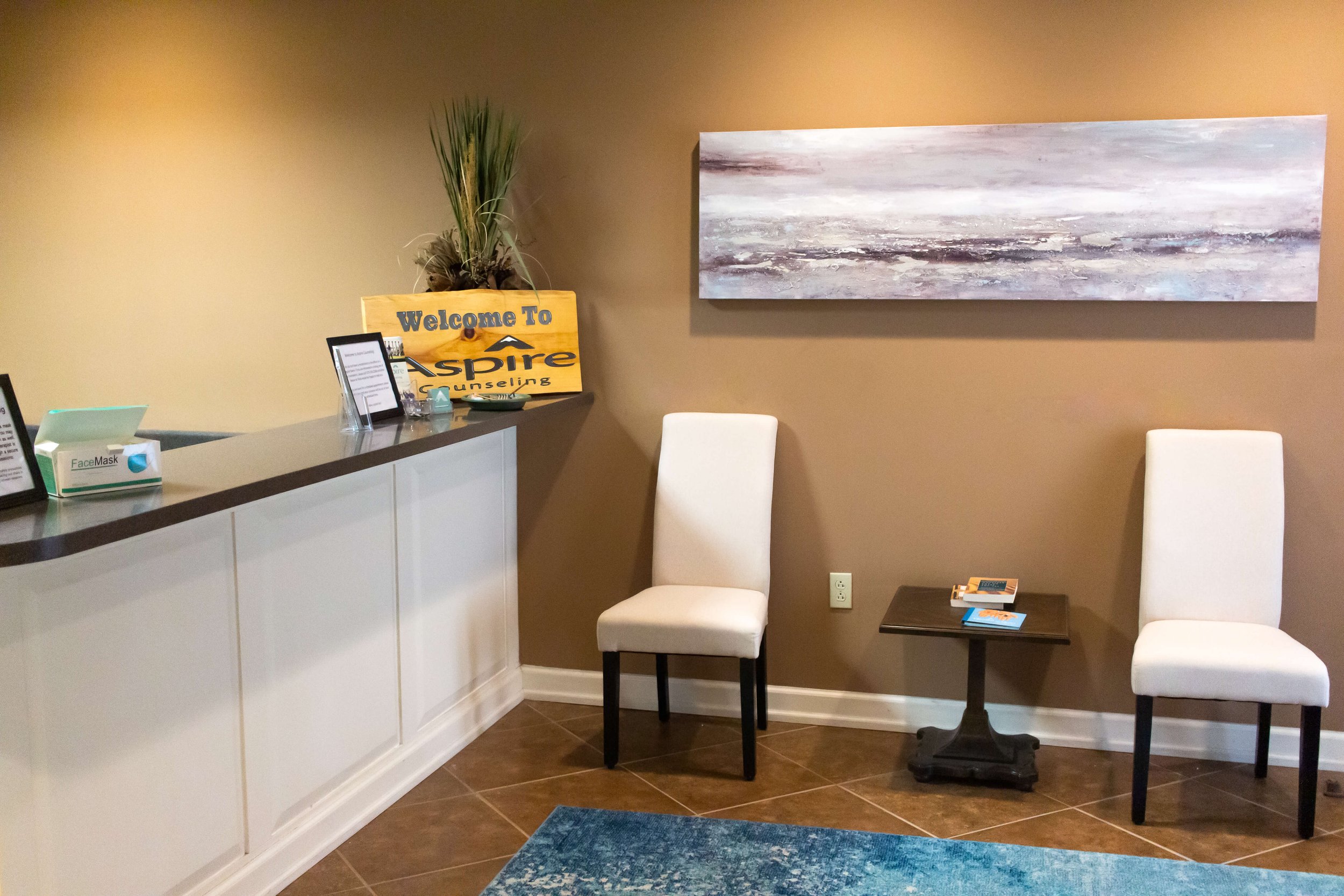
Our Columbia office is designed to feel calm from the moment you arrive. We have two separate waiting areas, adjustable lighting in every therapy room, and a lobby stocked with snacks, drinks, and a few things to settle into while you wait.
We believe therapy starts before the session begins.
For a lot of clients — especially those coming in for anxiety, trauma, or OCD — just getting to the office takes something. We don't want the environment to add to that load.
When you arrive, you'll find:
A calm, clean lobby, usually with soft music and a diffuser going
Two separate waiting areas, so you can find a quieter corner if you need one
Snacks and drinks — because some people come in hungry, and others are too anxious to notice they haven't eaten until they start to relax
Puzzles, books, and coloring supplies in the waiting area
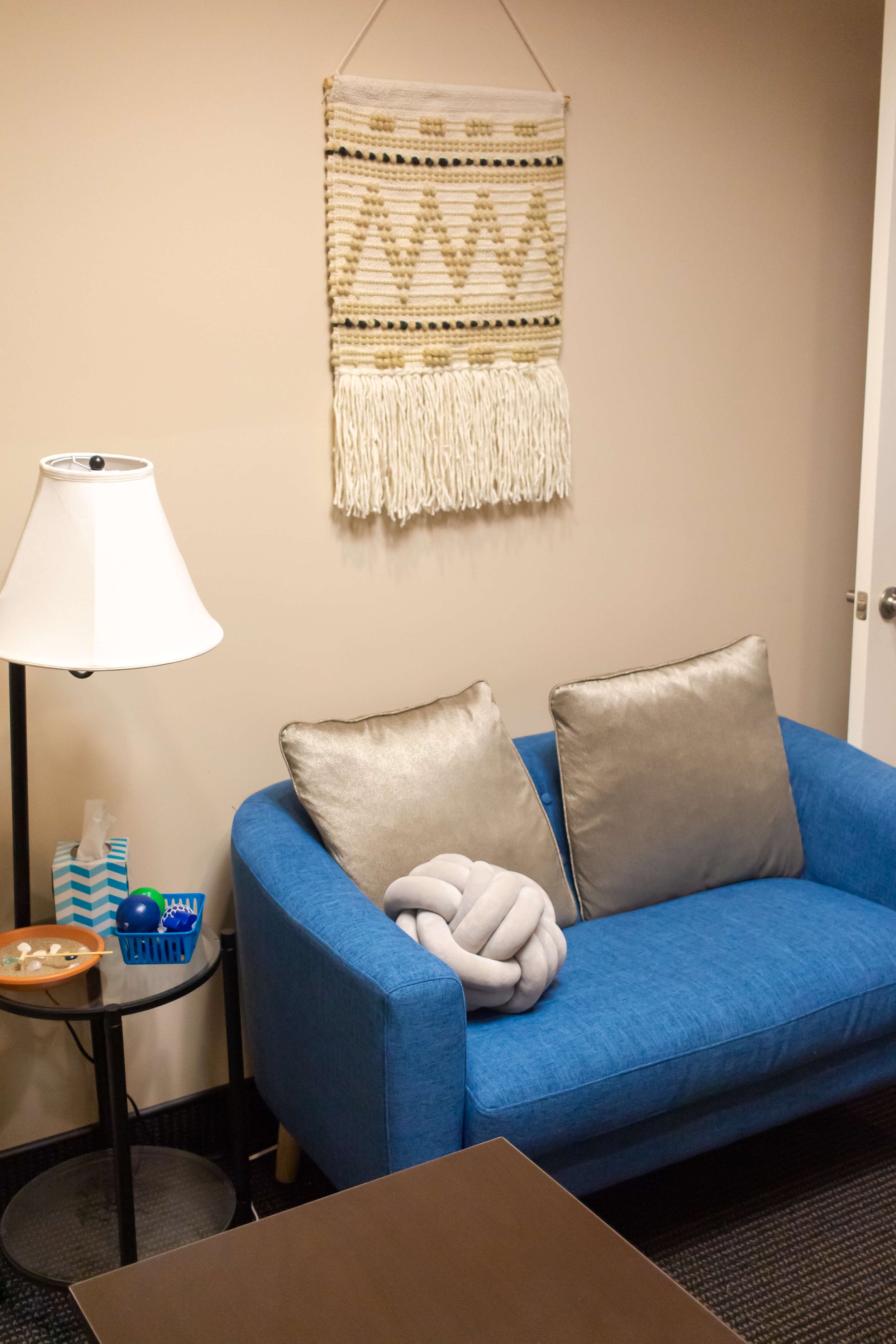
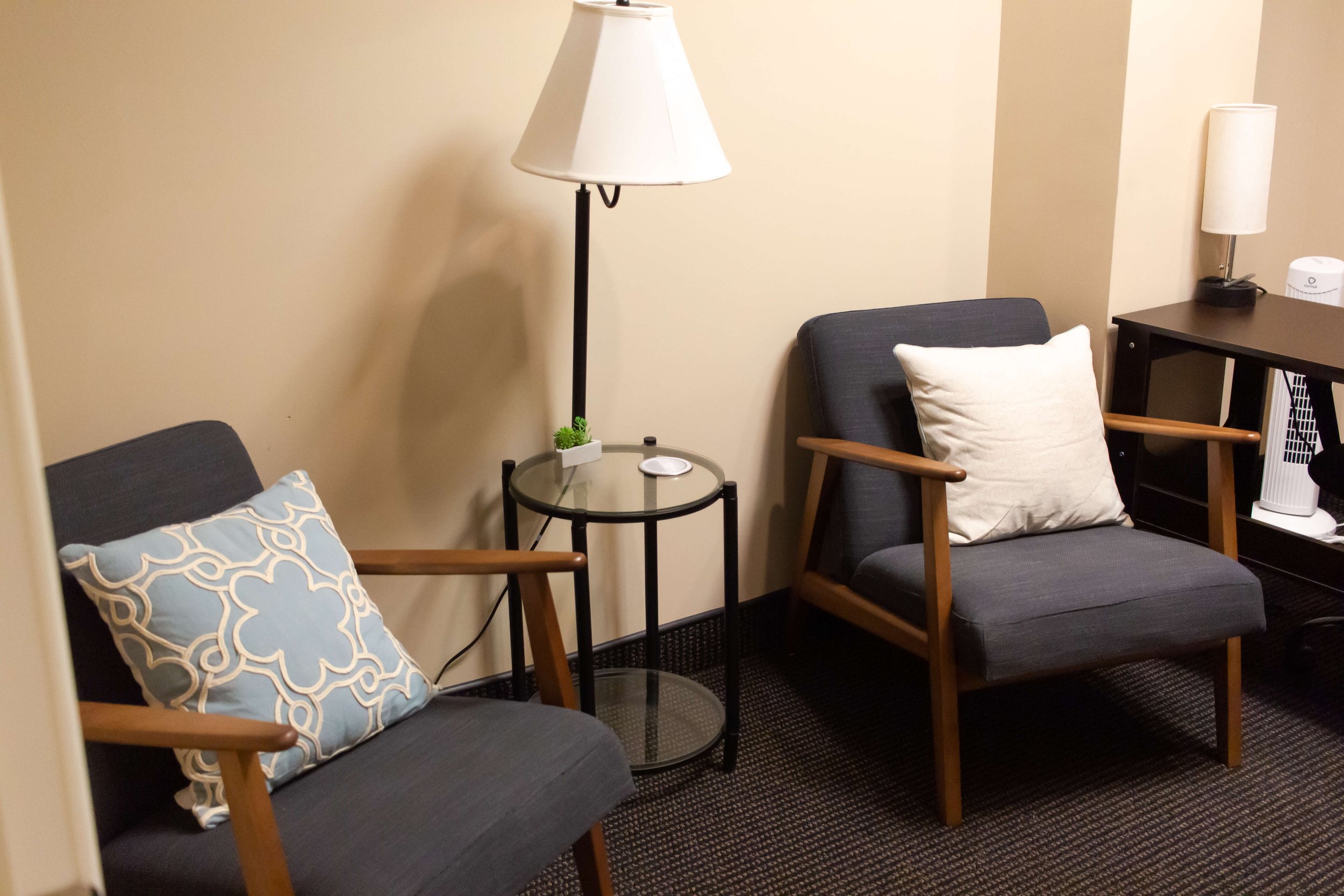
Lighting options in every therapy room — overhead lights can be turned off if bright light feels like too much
Therapy rooms that each have their own feel, but are all warm, tidy, and calm
Our space doesn't look like a doctor's office. It doesn't feel sterile or institutional. We've put thought into the details because we know those details affect nervous systems — and our clients' nervous systems have often been through a lot.





Can’t make it to our Columbia, MO office?
While we take great pride in our physical space and always enjoy seeing clients in the office, we understand that many people refer to meet with a therapist online these days. That is why our therapists have invested time and energy into learning how to provide the best possible online counseling services. In fact, more than half of our counseling services are now provided online. We use a secure video platform and make every effort to give you as comfortable of an experience as possible even when you’re attending online therapy or counseling.
If you are going to meet with a therapist online, we encourage you to think about creating a comfortable space for yourself. It’s important that you meet with your therapist from a space that ensures complete privacy. Additionally, you may think of what else may help you feel comfortable. For example, sitting at your desk and looking at a huge pile of work that needs to be done may not help you feel as relaxed as choosing a comfortable place in your living room.
We can meet with you for therapy online as long as you are located anywhere in the state of Missouri.
Begin Counseling in Missouri
If you live anywhere in the state of Missouri, our therapists can help. We offer counseling in our Columbia, MO counseling office, online or walk and talk therapy in local parks. You don’t have to stay stuck. We’re here to help and the first step is reaching out today.
Contact Aspire Counseling
2. Meet with a Therapist
3. Begin Moving Toward Healing
Visit Us
302 Campusview Dr
Columbia, MO 65201
Hours
By Appointment Only
Phone
(573) 328-2288
Where are you located?
Our Columbia office is at 302 Campusview Drive, Suite 201, Columbia, MO 65201 — in the Seven Oaks building directly behind Grand Cru restaurant, just south of the University of Missouri campus.
When you arrive, park on the upper level — not the lower level. Walk in through the main entrance, and our suite is immediately on your left through the frosted glass door. Come on in, take a seat, and your therapist will come out to meet you at your appointment time.
If you're coming from campus or downtown Columbia, take Providence Road south. You'll pass Stoney Creek Hotel and then see Grand Cru on your left. Turn left onto Carter Lane, then take the second right onto Campusview Drive. We're in the Seven Oaks building across from Campusview Apartments. We're a short drive from Rock Bridge High School and an easy trip from most of south Columbia.
Frequently Asked Questions
-
Yes. We work with children of various ages, teens, and adults. For younger children, we focus primarily on anxiety, trauma, and OCD — the areas where evidence-based treatment has the strongest research support for that age group, and where our child therapists have the most specialized training.
Our therapists who work with children hold training in TF-CBT (Trauma-Focused Cognitive Behavioral Therapy) and ERP for OCD. They're warm, patient, and experienced at helping kids feel safe enough to do real work.
If you're wondering whether your child is a good fit for our practice, reach out. We're happy to talk through it before you ever schedule an appointment.
-
We are a private-pay practice, which means we don't bill insurance directly. However, many clients with PPO plans are able to submit for out-of-network reimbursement. We work with Thrizer to help make that process as easy as possible.
We made a deliberate choice not to accept insurance. Insurance plans limit session frequency, cap the number of sessions, and require specific diagnoses that don't always fit the person in front of us. Private pay gives us the freedom to actually design your care around your needs.
Our therapists charge between $100 and $160 per session. If you'd like help understanding your out-of-network benefits before scheduling, our intake team can help you think through your options.
-
ERP (Exposure and Response Prevention) is the gold-standard, research-supported treatment for OCD. It works by gradually exposing clients to feared thoughts or situations while helping them resist compulsive responses. Without that piece, OCD tends to stay stuck or get worse over time.
The challenge with ERP is that it requires real training. It's not enough to understand the concept. Delivering ERP well means knowing how to build exposures carefully, support clients through high-anxiety moments, and adjust in real time. Our OCD therapists have that training as well as regular support from our ERP consultation team. If you or your child has OCD and has worked with a therapist in the past without much progress, ERP may be what was missing.
-
Both CPT and EMDR are evidence-based treatments for trauma and PTSD with strong research support. CPT (Cognitive Processing Therapy) works primarily through written and verbal processing — examining how trauma has affected your beliefs and reshaping those thoughts. EMDR uses bilateral stimulation alongside trauma processing to help the brain reprocess difficult memories.
In practice, one approach often fits a person's history and preferences better than the other. Some clients do better with the structured written work in CPT. Others find EMDR a better fit, especially when trauma memories feel more sensory or hard to put into words. Our therapists are trained in both, which means they can help you figure out which direction makes the most sense — or adjust if something isn't working.
-
Yes. All of our Columbia therapists offer telehealth sessions for clients located anywhere in Missouri. We use a secure, HIPAA-compliant platform. If you can't make it in person — or simply prefer meeting from home — telehealth is a fully supported option.
More than half of our sessions are conducted online. We've invested in making telehealth feel as close to in-person as possible. If you're meeting with us online, we'd encourage you to find a private, comfortable space where you won't be interrupted.
-
Our intake team does the matching. When you reach out, we'll ask about what you're working through, what you're looking for, and any preferences you have. Then we'll match you with a therapist whose training and approach fit your specific concerns.
You don't need to research every therapist on our team or figure out who specializes in what. That's our job. We want the match to feel right — clinically and relationally — because the relationship between you and your therapist matters a lot for how therapy goes.