
How to Take Action When You Don't Feel Ready: The ACT Matrix
Blog #5 in The Hexaflex: a 6 part series on Acceptance & Commitment Therapy
Something I notice about myself is that I have a hard time mowing my lawn.
It genuinely is one of my least favorite activities that is required with house maintenance. I can do the work around it for sure. I can accept the discomfort of going out in the heat. I can notice having thoughts that stop me from feeling ready to go outside and defuse from them. I can take a mindful moment and pause and check in with myself to get the full picture of what and how I'm feeling.
But it all changes very little, because my grass isn't mowed!
Taking one foot and putting it in front of the other is the only way we can really take action. In my case, it means doing something that I have little motivation to do and that is overwhelming and uncomfortable at times, especially as I write this in the heat of summer.
When I really don't want to do something, it means breaking it down into manageable chunks. I have to find my clothes, put them on, find my grass cutting shoes, put gas in the mower, step out into the heat, prime the mower, finally tug on the pull start and get walking.
What a task and a massive first world problem, but I'm reminded every second I write this looking at my tall grass in the front of my yard.
My difficulty with this task is committing to action. In the therapeutic world this often takes on an entirely different context.
What if you know what matters but still aren't doing it?
What I notice the most that ails the folks I work with in therapy is this problem that comes from having all the skills necessary and still feeling unsure or uncertain about next steps.
This is entirely common. I am having a conversation processing some horribly difficult emotions, and we find pause in our conversation, and I hear something along the lines of "Jordan, what now?"
I will often respond with something like "I wish there was a manual for times like these," but alas, there is no owner's manual to flip through and tell us the next 3 steps of changing our emotional tires.
What we can do is turn to a guide called the "ACT Matrix" shown below:
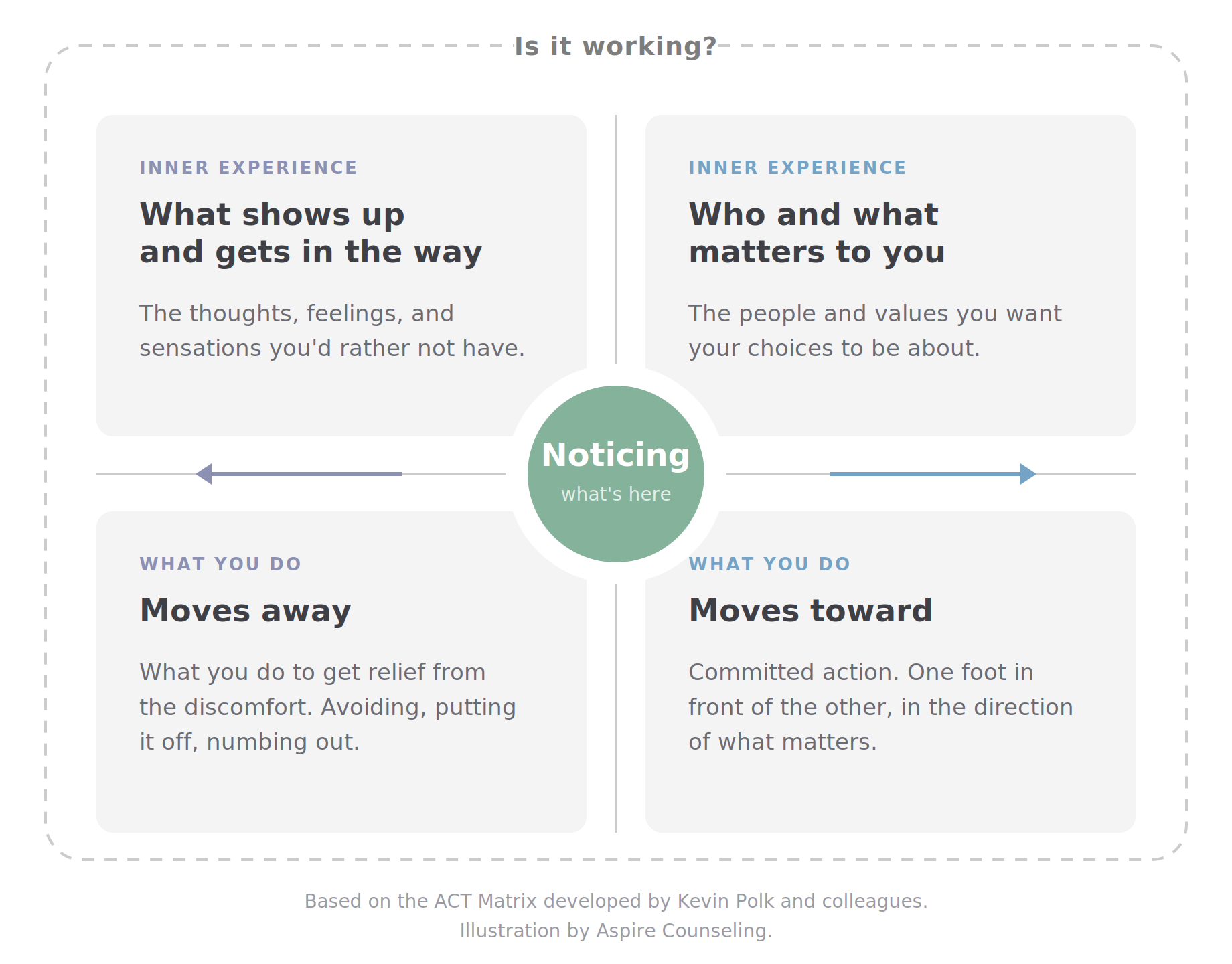
Using the ACT Matrix when you feel stuck
In many ways, the ACT Matrix summarizes all the components of ACT in a nutshell.
At the center of the image you see the word "noticing," that is you taking a look at your current experience. If I am using my grass cutting experience above, it's me stopping to ponder "what do I want to do next?" It gives some pause to your next steps.
Moves away
The arrow pointing left denotes the moves away from our values and what we would like to see change. It's all the "yucky stuff" I was discussing before:
"Do I really have to mow today?"
"If I go outside I'm going to get sweaty and I never enjoy that."
"Ugh! If I don't do it now, it'll get longer and I have to spend more time doing it next week and that makes me anxious."
Noticing my thoughts and feelings means that I will then be able to attune to the ways my brain searches for relief:
"Let's just stay in and do it tomorrow, I'd rather play video games."
"I need to let this anxiety pass now, let's watch Netflix."
Moves toward
On the flip side, the arrow to the right denotes moves towards my values and the things I wish to accomplish despite them being difficult. Pausing to reflect on values means identifying who and what is important to you regarding your next choice:
"I promised my partner that I would get this done today and I want to be a person who is accountable."
"I want to be able to spend time with my partner after I finish cutting the grass. The longer I prolong this, the longer I have to worry about it."
"Moves toward contentment" is otherwise "committed action:"
"I am putting one foot in front of the other because I want and need to. It's important to me to finish cutting the grass."
The question ACT keeps coming back to: is this working?
Lastly, there is an important ending to acknowledge about the ACT Matrix.
Around the entirety of the image, we see the phrase, "working?" This refers to the checking back that we have to do surrounding our actions.
Both directions, moving towards and away, are plausible and valid in the exercise. If I wish to play video games instead of mowing the grass, that can absolutely be my choice. If I wish to run outside and mow the grass right now, that is also certainly a valid and understandable choice.
When we ask ourselves if the action is still working, we are allowing ourselves to notice if the action we took was the right one at that moment as a chance to re-evaluate.
Committed action doesn't mean forcing yourself
Committed action isn't the same as always picking the productive looking option.
If I (real story) roll my ankle in the first 5 minutes of mowing the lawn, does it continue to be working that I push through and continue mowing? Limping through the rest of the yard isn't more values consistent. It's just stubborn.
Similarly, I've been playing video games for 8 hours and now it's cutting into my time I originally wanted to spend with my partner. Is that still a good use of my time? Probably not. But an hour of video games because I'm worn out and want to rest isn't avoidance either.
The answer to both of these questions is dependent on your experience at the moment.
At the end of the day, it is an exercise that shows that you have the autonomy and right to choose your actions and make the choice that makes most sense to you.
Begin ACT Therapy in Columbia, MO
If you've done the work of understanding your patterns and you still feel stuck on what to actually do next, that's a normal place to get stuck. It's also something therapy can help with.
At Aspire Counseling, we have therapists trained in Acceptance and Commitment Therapy who work with teens and adults. We have offices in Columbia and Lee's Summit, plus online therapy anywhere in Missouri.
To get started, reach out online or call us at 573-328-2288 in Columbia or 816-287-1116 in Lee's Summit.
Whenever you're ready for effective care and lasting change, we're here.
About the Author
Jordan Lascuola, LCSW, is a Licensed Clinical Social Worker at Aspire Counseling in Columbia, Missouri. He has completed more than 100 hours of training in Acceptance and Commitment Therapy and works with teens and adults. He has taken ACT courses taught directly (in person and online) by some of the greatest of the greatest in the ACT world since 2017. As a therapist, ACT is the treatment modality he uses the most. In other words, Jordan is an ACT therapist through and through.