
What to Do When Depression Makes You Want to Cancel Everything
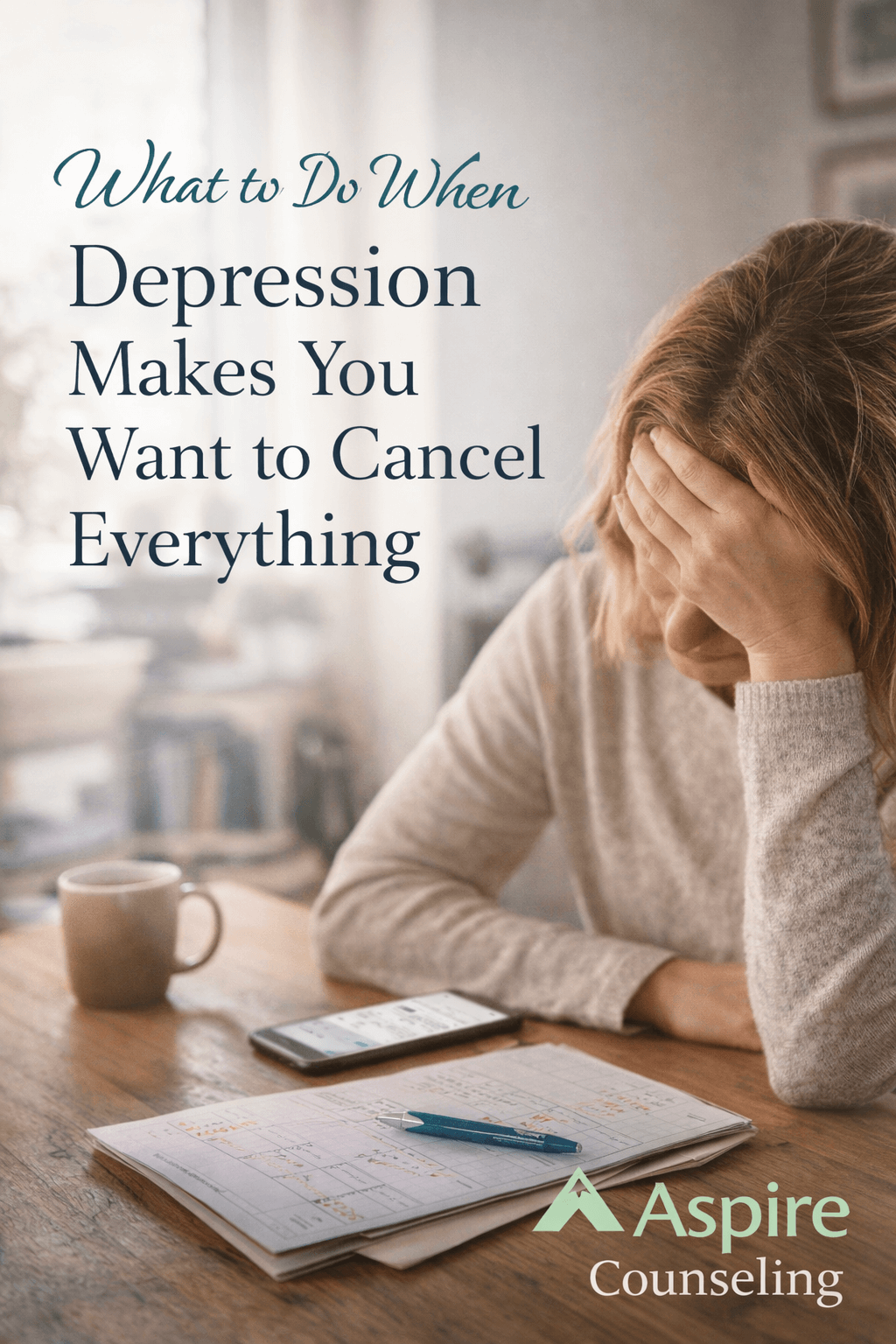
Depression doesn’t always look like crying in bed (though it can). Sometimes it looks like staring at your calendar and feeling a wave of dread. It looks like ignoring texts. Rescheduling appointments. Calling in sick when you “should” be able to push through.
If this is you, I want you to hear something clearly: this isn’t laziness. This is your nervous system trying to protect you the only way it knows how.
Why “canceling everything” makes sense in a depressed nervous system
From a polyvagal lens, depression often pulls people toward a shutdown state (sometimes called dorsal vagal). Your body is conserving energy. It’s not a character flaw—it’s a biological strategy: reduce demand, reduce risk, reduce overwhelm.
From an IFS (Internal Family Systems) lens, there may be a part of you whose job is to hit the brakes. This “Cancel Everything” part is usually trying to help. It may be protecting you from failure, judgment, conflict, disappointment, or even from feeling how painful things have been.
And from a psychodynamic perspective, this urge to withdraw can be tied to older patterns: the part of you that learned, early on, that needing support was unsafe… or that you had to perform to be loved… or that it was better to disappear than be a burden.
When depression shows up, it often activates all of these layers at once: your body shuts down, your protective parts take over, and old relational wounds get louder.
So what do you do when depression is telling you to cancel everything?
You don’t argue with it. You get curious, you get smaller, and you get strategic.
Step 1: Name the pattern (without shaming yourself)
Try this sentence:
“A part of me wants to cancel everything right now.”
That wording matters. It creates space. It’s different from “I’m failing” or “I’m ruining my life.” It’s also more accurate.
If it helps, ask (IFS-style):
What is this part afraid would happen if I didn’t cancel?
What is it trying to protect me from?
How old does this part feel?
You don’t have to force an answer. Even asking the question can soften the grip.
If you want a deeper read on how IFS works and what the research says, here’s a related Aspire post: Is IFS Therapy Legit: A Summary of the Research.
Step 2: Stabilize your body first (because your brain follows your body)
When you’re in shutdown, logic rarely works. You can’t “talk yourself” into energy you don’t have. Start with bottom-up regulation:
Pick one:
Sit with your back supported and press your feet into the floor for 30 seconds.
Put a hand on your chest and a hand on your belly and slow your exhale.
Step outside for 2 minutes and let your eyes look at the horizon.
Hold something warm (tea, heating pad) and notice the sensation.
Think of this as telling your nervous system: We’re not in danger. We’re just having a hard day.
This is not a cure for depression. It’s the first rung of the ladder. You’re widening your window of tolerance enough to make a next choice.
Step 3: Use a “Minimum Viable Day” plan (small enough that depression can’t veto it)
Depression loves all-or-nothing rules:
“If I can’t do it perfectly, why try?”
“If I can’t do everything, I should do nothing.”
This is where a CBT lens helps. Depression often distorts thinking into extremes, and those extremes lead to avoidance, which deepens depression.
If you want a quick refresher on CBT and the thought-feeling-behavior loop, see: What Does Cognitive Behavioral Therapy Do?
Your Minimum Viable Day plan is the opposite of all-or-nothing. It’s three tiny anchors:
Body: eat something + drink water
Light: 2 minutes outside or near a bright window
One task: the smallest possible “keep my life from sliding” action
take meds
pay one bill
send one email that says “I’m not at 100%—I’ll follow up tomorrow.”
shower or brush teeth (not both, if that’s too much today)
Then stop. Seriously. Minimum viable means “enough to interrupt the spiral,” not “enough to feel amazing.”
Step 4: Talk to the part that wants to cancel—then negotiate
Here’s a simple IFS-style script you can try:
“I get why you want to cancel. Thank you for trying to protect me.
What if we don’t do everything… but we do one small thing so tomorrow is easier?”
Often the protective part isn’t trying to destroy your life. It’s trying to reduce pain. When you offer a smaller plan, it may relax.
Step 5: Address the deeper story (the one underneath the calendar)
This is where psychodynamic work can be powerful.
Sometimes “canceling everything” isn’t just about energy. It’s about meaning:
“If I show up, people will see I’m not okay.”
“If I need help, I’m weak.”
“If I disappoint someone, I’ll be rejected.”
Those beliefs are rarely random. They usually come from somewhere.
A helpful question is:
“What does showing up cost me emotionally?”
If the cost is shame, fear of criticism, or the ache of feeling alone, that’s not something you fix with a planner. That’s therapy work—and it’s treatable.
Step 6: Do one connection, not ten
Depression isolates. Isolation reinforces depression.
You don’t need a big social plan. You need one thread of connection:
Text one person: “Not doing great. Can you check on me tomorrow?”
Ask for a low-demand hangout: “Want to sit on the couch and watch something?”
If you’re a parent: aim for “present-ish,” not perfect. Sit near your kid. Share a snack. That counts.
If anxiety is layered in (common), you might relate to this Aspire post: Overthinking Everything? How Anxiety Distorts Your Thoughts & How an Anxiety Therapist Can Help.
Step 7: Know when it’s time to get professional help
If you’ve been stuck in the cancel/withdraw cycle for more than a couple weeks, or you’re noticing work, relationships, or your basic functioning sliding, you don’t have to white-knuckle your way out.
Effective therapy is not just “talking about how bad you feel.” It should include a plan, skills, and a way to track progress.
Two Aspire posts you might find helpful here:
What Does Effective Therapy Actually Look Like? Understanding Treatment Outcomes (https://aspirecounselingmo.com/blog/what-does-effective-therapy-actually-look-like-understanding-treatment-outcomes) (Aspire Counseling)
What Should My Therapist Actually Be Doing in Counseling Sessions? (https://aspirecounselingmo.com/blog/what-should-my-therapist-actually-be-doing-in-counseling-sessions) (Aspire Counseling)
And if you’re local and want a gentle “start small” option, here’s one that’s Lee’s Summit–specific: Lee’s Summit Self Care Resources (https://aspirecounselingmo.com/blog/lees-summit-self-care-resources). (Aspire Counseling)
Important note about safety
If you’re having thoughts of self-harm or suicide, you deserve support immediately. In the U.S., you can call or text 988 (Suicide & Crisis Lifeline). If you’re in immediate danger, call 911 or go to the nearest emergency room.
A final reframe to carry with you
When depression makes you want to cancel everything, your job is not to “snap out of it.”
Your job is to:
get compassionate and curious with the part that’s shutting things down,
support your nervous system first,
choose one small action that keeps your world from shrinking.
Progress is often quiet at first. And it’s almost never linear. But it is possible to come back to yourself—one doable step at a time.
Begin Counseling for Depression in Lee’s Summit
Living with depression is hard. Convincing yourself to actually pick up the phone and talk to a therapist is hard. Getting to our office can feel monumental. But it’s worth it. Because you CAN feel better. Our therapists are here to help. Contact Aspire Counseling today. We’ll take the time to ask a few questions and make sure you’re pairing you with the right Lee’s Summit therapist. Lee’s Summit too far to come for appointments? No worries, we also offer telehealth counseling to anyone in the state of MIssouri.
About the Author
Jessica Oliver MSW, LCSW is the clinical director and founder of Aspire Counseling. She started her career way back in 2010 learning about Dialectical Behavior Therapy as she treated some of the most seriously depressed individuals in the state of Missouri. She watched countless clients go from feeling so depressed they didn’t know how to go on to living fulfilling, joy filled lives that are truly worth living. Jessica learned about depression from some of the leading experts and considers her time on a DBT consultation team to be a highlight of her career. While she doesn’t offer comprehensive DBT anymore, she still is very, very passionate about making sure that people who are depressed recieve high quality, evidence based counseling services. She’s hired therapists at Aspire Counseling who offer several different depression counseling modalities that we know work. This gives us the ability to really pair each client with the right person while making sure we’re always offering counseling that really, truly works.